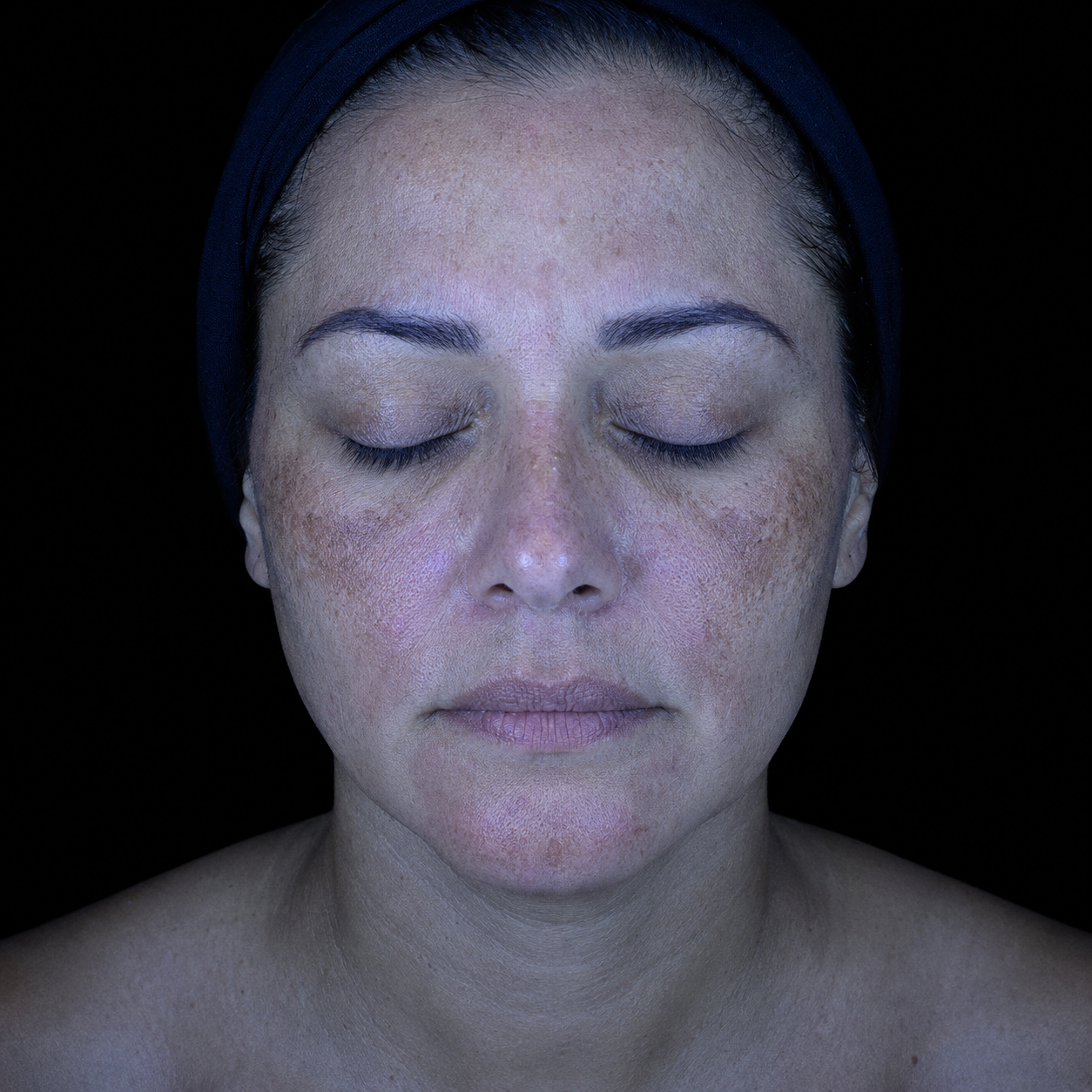
Depigmentation programmes treat stubborn pigmentation — melasma, sun damage, post-breakout dark marks — by switching off excess melanin production at the source, not just polishing the surface. At Omnia in Hilton and Ballito, we run medically supervised Cosmelan® and Dermamelan® programmes: an in-clinic professional peel followed by a prescribed home phase. Evidence-based, and — unlike many light treatments — safe for darker skin tones (Fitzpatrick I–V).
So many of us carry pigment-prone skin — the melasma, the marks that linger long after a breakout has gone. Harsh one-off treatments can make it worse. A supervised programme works with your skin, never against it.
The symmetrical patches — cheeks, forehead, upper lip — driven by hormones and sun. The concern Cosmelan® was built for, and the one we treat most.
Decades of KZN sunshine, accumulated as spots and mottling. The programme clears the record; SPF keeps it clean.
The dark souvenirs skin keeps after acne, irritation or injury — especially in melanin-rich skin. Suppressed at the source while skin renews.
Not one spot — a general unevenness that make-up manages daily. The programme restores clarity across the whole canvas.
Pigmentation rarely stops at the jawline. Treatment zones extend where your pigment does.
Dermamelan® Intimate — a discreet, medically supervised programme for intimate-area pigmentation. Handled with complete professionalism.
Pigment wasn’t made in an hour, and it isn’t unmade in one either. The results come from the structure: one clinic day, then weeks of prescribed home care doing the real work.
A medical skin assessment — skin type, pigment depth, triggers, history. This determines your programme, your timeline and your realistic outcome.
Fee credited to programmeThe professional depigmenting mask is applied in clinic — 45–60 minutes, mild tingling. Expect redness and visible peeling for 5–7 days after.
Plan a quiet weekYour prescribed depigmentation routine takes over, suppressing melanin production for weeks. First results at 2–4 weeks; full clarity by 6–12.
This is where results are madeMaintenance cream plus daily pigment-control SPF keep production switched off — because pigment managed is pigment gone.
SPF 50, every single day
Pigmentation is an iceberg: what shows on the surface is a fraction of what sits beneath, already on its way up. Our skin imaging shows the full picture before we start — pigment depth, distribution, and damage that hasn’t surfaced yet — so your programme is prescribed from data, not a glance in good lighting.
And because depigmentation programmes work chemically rather than by light, they are one of the safest, most effective options for darker and pigment-prone skin tones — the very skin that IPL and aggressive lasers can harm. This is precision work for exactly the skin South Africa has.
Depigmentation is a full programme — clinic day, home phase and maintenance — so we price it that way, upfront, at your assessment.
The professional depigmenting peel, applied in clinic — currently at a reduced price
The prescribed home routine that does the real work over the following weeks
Keeps melanin production suppressed long after your programme ends
Your assessment confirms which programme fits your skin and budget before anything begins — including lighter-touch alternatives (Melan Tran3x, brightening peels) where a full Cosmelan® programme isn’t needed. Assessment fee credited to your programme.
The pigment-control range we prescribe is the range we stock. Prescribed at your assessment, delivered to your door for every top-up after.
The in-clinic phase is followed by real, visible peeling — redness, tightness and shedding for roughly 5 to 7 days, like a strong sunburn resolving. This is expected, and we prepare you for it properly. Temporary sensitivity, dryness and mild irritation during the home phase are common and managed with the barrier-support products built into your programme.
And the honest caveat we’d rather you hear from us: melasma is managed, not cured. Hormones and sun can reactivate it after any treatment, anywhere. That is not a reason to avoid treatment — it’s the reason the maintenance phase and daily SPF are part of the programme, not optional extras. Depigmentation is not suitable during pregnancy or breastfeeding, over active skin disease, or alongside certain medications — all confirmed at your medical assessment.
This page is general information, not medical advice. Treatment decisions are made in consultation with a medical professional. Page medically reviewed by Dr Nicky Potgieter · Last updated July 2026.
Yes — Cosmelan® is one of the world’s most used professional melasma protocols, and melasma is the concern we treat most. Honestly though: melasma is managed, not cured. The programme dramatically reduces it; maintenance and daily SPF keep it away.
Yes — one of its defining advantages. Cosmelan-type programmes are suitable for Fitzpatrick types I–V, including the pigment-prone skin so common in South Africa, where light-based treatments can carry real risk.
Visible reduction typically starts at 2–4 weeks, with full results over 6–12 weeks as the home phase continues suppressing melanin production.
Yes — visible redness and peeling for about 5–7 days after the clinic day, similar to strong sunburn shedding. Most patients plan it before a quieter week. After that, no further downtime.
The Cosmelan 1 in-clinic treatment is currently R14,750 (standard R18,500); the Homecare Pack is R9,995 and Cosmelan 2 maintenance R6,635. Your exact programme and total are confirmed at assessment — including lighter alternatives if a full programme isn’t needed.
Long-term, when maintenance is followed — daily SPF and the maintenance cream keep production suppressed. Sun, hormones or stopping maintenance can let pigment gradually return, especially with melasma.
IPL breaks down existing spots with light — best for discrete sun damage on lighter tones. Cosmelan switches off overproduction chemically — best for melasma, widespread pigment and darker tones. Your assessment decides; sometimes they’re sequenced.
Yes — post-inflammatory hyperpigmentation (PIH) responds well to depigmentation programmes, which suppress the excess melanin response while skin renews. Common and very treatable, especially in melanin-rich skin.
UV is the accelerator pedal for melanin — even brief unprotected exposure can reactivate the pigment you’re removing. Daily SPF 50 (we prescribe Melan 130 Pigment Control) protects your investment.
Omnia runs Cosmelan® and Dermamelan® programmes at two KwaZulu-Natal locations: Hilton (serving Pietermaritzburg and the Midlands) and Ballito (serving the North Coast). WhatsApp +27 82 838 8741 — we usually reply within five minutes.
Skin imaging, an honest read of your pigment and its triggers, and a programme designed for your skin — with the assessment fee credited when you begin.
Omnia · Hilton Health, Hilton Avenue, Hilton, KwaZulu-Natal
WhatsApp (+27) 82 838 8741 · admin@omniahealth.co.za
Book at HiltonOmnia · Ballito, KwaZulu-Natal · Suite 25A, The Well, Corner of Kristy close and Albertina way, Ballito, 4420
WhatsApp (+27) 82 838 8741 · admin@omniahealth.co.za
Book at Ballito